A deliberate search of current catalogues turns up only two books published on artificial intelligence for banking, and both are recommended below: Deep Learning in Banking and Financial AI in Practice. The book this page originally reviewed, Hands-On Artificial Intelligence for Banking, is a 2020 Packt Publishing title that remains a decent foundations text on classical machine learning in banking. Three books now serve you better than that one alone.
Only two of the three are newer than the Packt book: Deep Learning in Banking (January 2026) and Financial AI in Practice (due September 2026), both covering large language models, generative AI, and RAG. Advances in Financial Machine Learning, by López de Prado, dates to 2018, two years older than the Packt book, and earns its place on merit alone. Methodology books age differently than tooling books, and nothing has superseded it on backtest overfitting.
Deep Learning in Banking (2026), the one to buy first
Deep Learning in Banking: Integrating Artificial Intelligence for Next-Generation Financial Services, by Cristián Bravo, Sebastián Maldonado and María Óskarsdóttir, is a Wiley title published in January 2026, running 336 pages under ISBN 9781394295371 in print. It is the direct structural successor to the Packt book: same domain, same practitioner intent, six years newer.
The book covers image processing and convolutional neural networks, text data and transformers, financial contagion and network models, and time series in banking. It also covers generative AI and large language models, multimodal data and information fusion, and fairness, accountability, explainability, and causality, closing with a chapter on the future of AI in banking.
That spread tracks closely with the real applications of AI in banking that banks are shipping now. The generative AI and large language models chapter is the one artificial intelligence for banking veterans will notice the Packt book has no equivalent of.
The chapter on fairness, accountability, explainability, and causality maps onto what the EU AI Act now requires of high-risk banking AI systems. See our note on where AI in banking still falls short for the compliance angle.
On the authors: Cristián Bravo is a Full Professor and the Canada Research Chair in Banking and Insurance Analytics at Western University, where he directs the Banking Analytics Lab. He co-authored Profit-Driven Business Analytics with Wouter Verbeke and Bart Baesens. Wiley’s own description calls the book “structured for both academic and professional use”.
The book leans more academic than the Packt title. A reader who wants nothing but runnable notebooks should pair it with the Manning book below: one for artificial intelligence for banking concepts, one for production code.
This article contains affiliate links. If you buy through them, we may earn a commission at no extra cost to you. Find the book on Amazon or the publisher’s page.
Financial AI in Practice (2026), the hands-on companion
Financial AI in Practice: A Playbook for Credit, Fraud, and Investment Systems, by Taehun Kim, is in Manning’s Early Access Program today. All chapters are complete, with publication estimated for September 2026; it has not published yet, so treat any other listing you find for it as unverified.
Financial AI in Practice is the closest one-to-one modern replacement for a reader who liked the Packt book because it was hands-on. It covers credit scoring and fraud detection systems, model development and deployment, graph analytics for fraud exposure, large language models for financial analysis, and hybrid strategies that combine machine learning models with LLM-driven insights. It also covers ROI and stakeholder alignment, ground most technical books skip.
Manning’s own description promises you will learn to architect secure, compliant generative AI with RAG techniques, material no 2020 book on artificial intelligence for banking could have included. We cover the wider trend in generative AI in banking.
Kim’s author bio describes over a decade building AI systems that perform on the front lines of the finance industry. MEAP means you read chapters as they finalise and receive the finished ebook the day it publishes; sign up for our newsletter and we will let you know the day it ships. For the deployment side of this work, see our piece on AI in banking customer service.
Read more at the Manning book page.
Advances in Financial Machine Learning (2018), the methodology reference that has not aged
Advances in Financial Machine Learning, by Marcos López de Prado, is a Wiley book from February 2018, running 400 pages under ISBN 9781119482086. It is not a banking book, and it is not a beginner’s book.
It is the standard reference on how to avoid fooling yourself with financial machine learning: backtest overfitting, sample weighting, and cross-validation that survives serial correlation. It is the book that stops you shipping a model that looked great in a notebook.
Yes, it is from 2018, older than the Packt book this article demotes, and that is deliberate. Tooling books rot because tooling changes; methodology books do not, because the ways a backtest can lie to you have not changed. Anyone building artificial intelligence for banking on backtested trading or credit signals should read this before shipping a model.
López de Prado’s newer Element, Causal Factor Investing: Can Factor Investing Become Scientific? (Cambridge University Press, October 2023, 92 pages), extends the argument into causal inference and is open access under a CC-BY-NC licence. It is a short work on factor investing, not a replacement for the 2018 book.
Find it on Amazon or the publisher’s page.
Hands-On Artificial Intelligence for Banking (2020), still worth it with caveats
Jeffrey Ng, CFA, and Subhash Shah wrote this book for Packt Publishing, first published on 10 July 2020. Its chapter structure is unusually well matched to real banking work: demand forecasting, client procurement, loan pricing, portfolio management with the Treynor-Black model, market prediction, sentiment analysis, graph databases for network analysis, and a wealth-advisor build. That range is why the book still has value six years on.
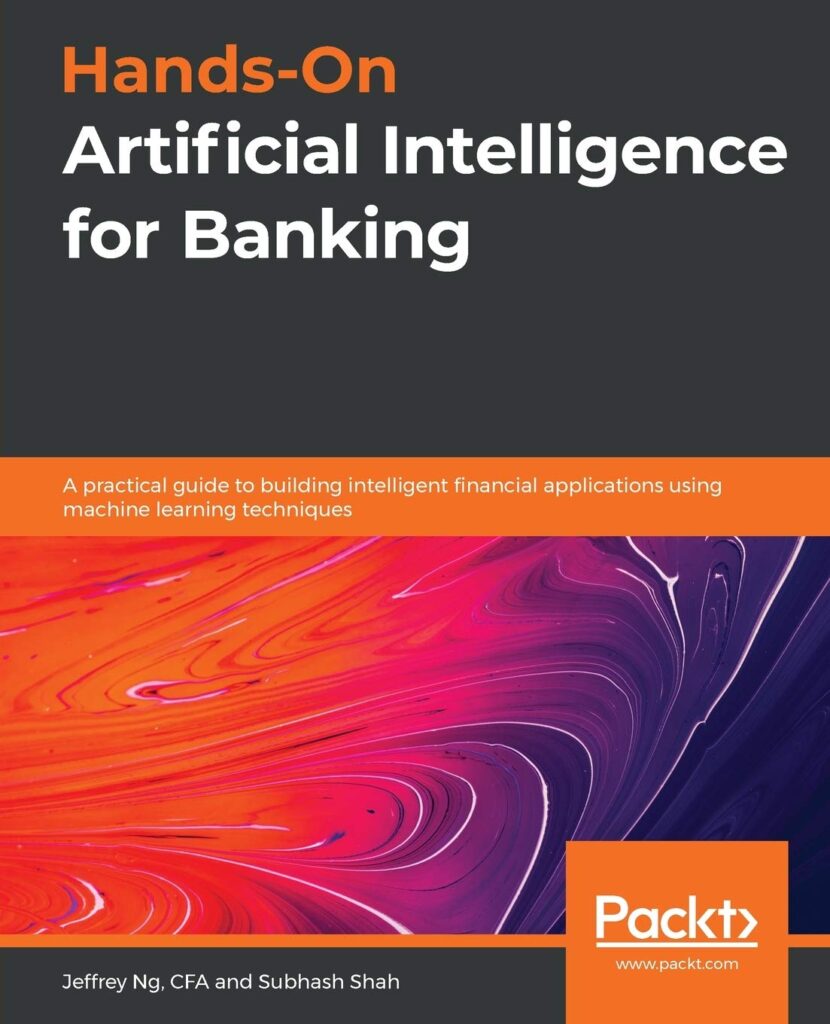
Packt publishes the book’s complete code on GitHub, free, under an MIT licence, at github.com/PacktPublishing/Hands-On-Artificial-Intelligence-for-Banking. It runs eight chapter folders covering chapters two through nine, so you can inspect most of the code before you buy. Not everything is there: there is no Chapter01 or Chapter10 folder.
Problem one: the repository’s stated requirements are Python 3.5+ and PyTorch 1.x, alongside SQLite 3.11, MongoDB, and Neo4j Community. Python 3.5 is long past end of life, and PyTorch is now on 2.x, so the examples need adaptation on any current machine.
Problem two: the data chapters use Quandl, acquired by Nasdaq and rebranded as Nasdaq Data Link. The quandl Python package was superseded by nasdaq-data-link, so code calling the old endpoints needs updating before it will run.
Problem three: the sentiment-analysis chapter collects data from Twitter. Free API access was heavily restricted from 2023, and the platform is now X, so that step no longer runs as written. Point readers at news APIs, Reddit, or a financial-news dataset instead.
The book has no large language models, no generative AI, no RAG, and no agentic systems, and it says nothing about the EU AI Act.
Annex III high-risk obligations covering creditworthiness and credit-scoring systems apply from 2 December 2027, not 2 August 2026: the Digital Omnibus amendment postponed that deadline, though many published articles still quote the superseded date. What does take effect on 2 August 2026 is general applicability, Article 50 transparency, and the Commission’s power to fine general-purpose AI model providers. Prohibited practices and AI literacy applied from 2 February 2025, governance and penalties from 2 August 2025.
Read the regulation itself or the European Commission’s summary of the framework.
The book is still a reasonable buy for classical machine learning worked through in a banking context, provided you are comfortable porting six-year-old code. It should no longer be the first artificial intelligence for banking book anyone buys. Find it on Amazon.
If you want the academic treatment
Three academic titles sit next to these books, useful if you want the peer-reviewed version of the same ground. Finance and Large Language Models, edited by Paul Moon Sub Choi and Seth H. Huang (Springer Singapore, August 2025), is a peer-reviewed collection on LLMs and AI agents in finance and trading.
Generative AI in Finance and Law: Innovation, Regulation, and Technological Developments, edited by Nadia Mansour and Lorenzo M. Bujosa Vadell (Springer, April 2026), is regulation-heavy and useful if the legal angle interests you more than the technical one.
Machine Learning in Finance: From Theory to Practice, by Matthew Dixon, Igor Halperin, and Paul Bilokon (Springer, July 2020), is aimed, in the publisher’s words, at “advanced graduate students and academics in financial econometrics, mathematical finance and applied statistics, in addition to quants and data scientists”.
These are academic collections at academic prices, so a practitioner who wants artificial intelligence for banking as runnable code should skip them and return to the four books above.
Which one should you read?
The three books split the work of artificial intelligence for banking by role, so match yourself to one before you buy all three. For the wider picture, start with our hub on AI in banking and payments.
A data scientist joining a bank starts with Deep Learning in Banking and keeps López de Prado on the desk for anything that will be backtested.
A developer who wants to ship this quarter goes straight to the Manning MEAP, the only one of the three written around production systems.
A risk or compliance lead who does not write code reads the fairness, accountability, explainability, and causality chapter of Deep Learning in Banking, then its forward-looking closing chapter, and stops there.
Someone learning classical machine learning on a budget can still get value from the Packt book, provided they expect to port the code.
Talk to Amperly before you buy
Reading about artificial intelligence for banking is one step; deploying it inside a real bank, with real compliance constraints, is another. Amperly works with banking and fintech teams on exactly that gap.
If you are weighing which of these four books applies to your team’s next project, or you would rather skip the reading list and get straight to a working system, book a free consultation and we will help you scope artificial intelligence for banking work that fits your bank’s actual constraints.